-
Wed04Nov2026Fri06Nov2026Ghent University
UBanCS colloquium — Ubangi, Bantu and Central Sudanic: Mosaics of Languages, Genes, and Material Cultures in Central Africa
Show contentSubmission Deadline: 28-Feb-2026
As part of the ERC-funded CongUbangi project, this colloquium aims at bringing together scholars from different disciplines interested in Ubangi, Bantu and Central Sudanic languages and language speaking-communities in northern Republic of Congo, southern Central African Republic and northern Democratic Republic of Congo. Spanning multiple ecozones within the Congo rainforest, this area is home to an intricate demographic configuration where Bantu (Niger-Congo) and Central Sudanic (putative Nilo-Saharan) speaking groups are interspersed with Ubangi groups. The internal relationships among groups lumped under the label “Ubangi” are unclear. While their individual Niger-Congo affiliation looks promising, this is based on very little evidence. Linguistic hallmarks of this area include multidirectional language shift, contact and linguistic enclaves.
The region’s linguistic diversity is matched with human genetic diversity. The few available studies suggest significant genetic differentiation among populations also having distinct cultural and/or linguistic backgrounds, but genetic sampling is insufficient compared to other parts of Africa, especially among Ubangi and Central Sudanic speakers. Further, nothing is known about admixture patterns which might reveal the dynamics of early contacts in the region.
Archaeological research within the region has been sparse, leaving large gaps in the history of pre-colonial populations and population movements. While a deep-seated hypothesis deprived of linguistic or archaeological evidence argues that Bantu were the first to settle in this region, the astonishing geographic fragmentation of Ubangi subgroups such as Mundu-Baka and Mbaic and of Central Sudanic subgroups such as Sara-Bongo-Bagirmi, suggests that these might descend from the earliest layers of occupation in the region. Likewise, ethnoarchaeological data has revealed a continuity between Early Iron Age communities and the Ubangi speakers that inhabit the region today, suggesting the possible antiquity of these groups in the region.
With this framework in mind, we welcome contributions from linguistics, genetics, archaeology and related fields dealing with:
- Phonological and/or morphosyntactic accounts of yet undocumented or poorly known languages of the region
- Language contact phenomena (esp. borrowings and vocabulary shared across different language families)
- Linguistic features spreading areally through contact
- Enclaved varieties (language islands)
- Language shift
- Language stratigraphy
- Reconstruction (and comparison) of proto-languages of Ubangi, Bantu and Central Sudanic subgroups
- Methods and challenges with internal classificatory attempts within Ubangi, Bantu and Central Sudanic
- Population genetics
- Metallurgy, including iron production
- Monumentality of Bouar and adjacent regions
- Pottery analysis (e.g., stylistic, formal, and petrology)
- Lithic studies of Late Stone Age (and/or earlier) materials
- Population movements, including the Bantu Expansion
- Ethnography (e.g., hunting/foraging, pottery and iron production)
- Interactions between autochthonous foragers and pottery-producing communitiesDeadlines:
Abstract submission: Submit an abstract of maximum 500 words (excluding references and/or figures) in pdf format to ubancs@ugent.be by 28th February 2026Notification of acceptance: 30th April 2026
For all questions, please contact the organizers at ubancs@ugent.be.
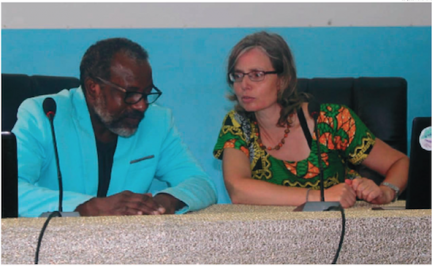 Camille Mbulu N’fuka-Malendji (Alliance Française Cabinda) & Heidi Goes (BantUGent) at a language planning conference in Cabinda, Angola, October 25, 2019 (© Edições Novembro)
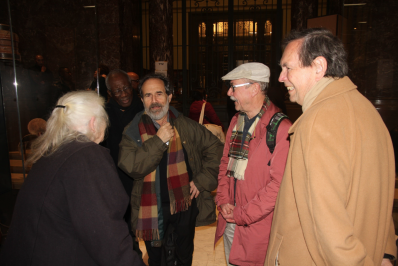 Visiting the then recently renovated AfricaMuseum in Tervuren during the International Conference on Reconstructing Proto-Bantu Grammar, November 21, 2018, from left-to-right: Claire Grégoire, Jean-Georges Kamba Muzenga, Larry Hyman, Thilo Schadeberg & Gérard Philippson (© Gilles-Maurice de Schryver)