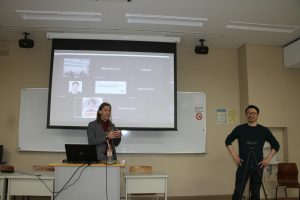
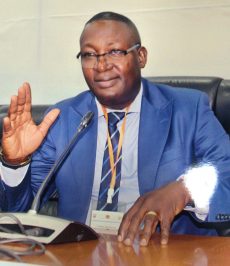
Prof. Jean-Pierre Donzo (ISP-Gombe, Kinshasa) at BantUGent for a research stay

From April 4 until June 30, 2023, Prof. Jean-Pierre Donzo (ISP-Gombe, Kinshasa) is on a BantuFirst-funded research leave at Ghent University to

  1. work on the new data he collected on Lotwa Bantu languages during a BantuFirst-funded fieldwork mission in the Sankuru province last year;
  2. prepare a new phylogenetic study on Bantu languages of the Congo Rainforest with Guy Kouarata, Sara Pacchiarotti and Koen Bostoen;
  3. continue his historical-comparative research on the velar merger in Central-Western Bantu languages with Sara Pacchiarotti and Koen Bostoen;
  4. prepare new fieldwork on Lotwa Bantu languages in the Kasai province.

For more info, check here.

Sebastian Dom (BantUGent) obtains a senior postdoctoral fellowship from FWO

Congratulations to Sebastian Dom (BantUGent) for obtaining a FWO senior postdoctoral fellowship for the research project titled “A historiography of Kikongo language studies and management (1624-1960)” under the supervision of Prof. Michael Meeuwis!  Sebastian obtained his PhD at Ghent University in 2018 with a FWO-funded dissertation titled “Bantu verbal derivation and tense/aspect from a historical-comparative perspective: the Kikongo Language Cluster and beyond”. After a postdoctoral fellowship at the University of Gothenburg in Sweden, where he worked in a project on valency-decreasing alternations in East Ruvu Bantu languages from TanzaniaBantUGent welcomes him back at the alma mater to continue his research on Kikongo. His research focuses on verbal morphology, morphosemantics and morphosyntax in Bantu languages, and more specifically on tense/aspect and valency, from a descriptive, comparative and historical perspective.

Sebastian Dom - Academia.edu


Prof. Igor Matonda (UNIKIN) at BantUGent for a research stay

From March 24 until June 27 Prof. Igor Matonda (UNIKIN) is on a BantuFirst-funded research leave at BantUGent. Apart from consulting and exchanging with colleagues within our research group , the main goals of his stay are to

  1. participate in BantuFirst workshop An Archaeology of the Bantu Expansion: early settlers south of the Congo rainforest (March 29-30, 2023),
  2. prepare the forthcoming joint volume An Archaeology of the Bantu Expansion: Early Settlers South of the Congo Rainforest (Routledge) of which he is co-editor;
  3. present online the talk titled Mapping the Archaeological Landscape of the Kwilu-Kasaï River Network, DRC at the 26th Biennial Meeting of the Society of Africanist Archaeologists at Rice University.

For more info, check here.
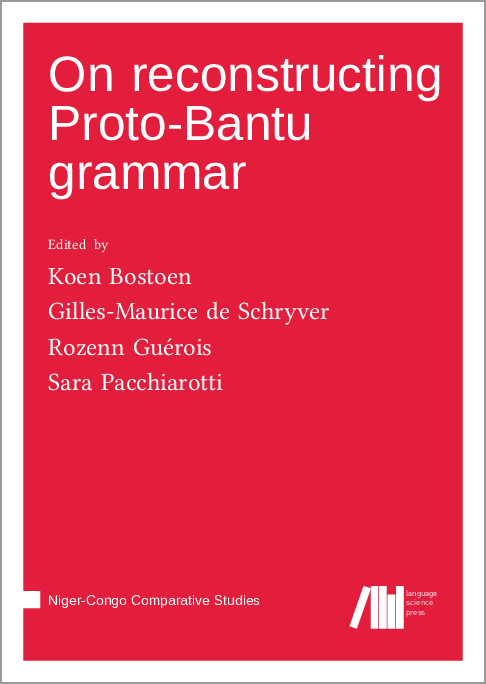
New BantUGent book on Proto-Bantu grammar out

This book is about reconstructing the grammar of Proto-Bantu, the ancestral language at the origin of current-day Bantu languages. While Bantu is a low-level branch of Niger-Congo, the world’s biggest phylum, it is still Africa’s biggest language family. This edited volume attempts to retrieve the phonology, morphology and syntax used by the earliest Bantu speakers to communicate with each other, discusses methods to do so, and looks at issues raised by these academic endeavours. It is a collective effort involving a fine mix of junior and senior scholars representing several generations of expert historical-comparative Bantu research. It is the first systematic approach to Proto-Bantu grammar since Meeussen’s Bantu Grammatical Reconstructions (1967). Based on new bodies of evidence from the last five decades, most notably from northwestern Bantu languages, this book considerably transforms our understanding of Proto-Bantu grammar and offers new methodological approaches to Bantu grammatical reconstruction.

https://langsci-press.org/catalog/book/373

book cover

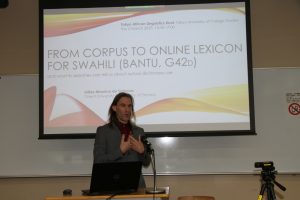
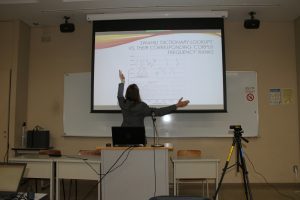
Minah Nabirye and Gilles-Maurice de Schryver talk at Tokyo African Linguistics Knot

When? Thu 2 March 2023, 14:30-17:00 (Tokyo time)
Where? Venue at Tokyo University of Foreign Studies
Who and what?
• Minah Nabirye: Language documentation for Lusoga (Bantu, JE16)
• Gilles-Maurice de Schryver: From corpus to online lexicon for Swahili (Bantu, G42d), and what its searches can tell us about actual dictionary use
Contact person: Professor SHINAGAWA Daisuke

http://www.tufs.ac.jp/tokyo-african-linguistics-knot/2023/02/dddlingtalk20225.html

From corpus to online lexicon for Swahili, and what its searches tell us about actual dictionary use